Stacker service is a recurring task in many forklift workshops, logistics centres, warehouses and industrial facilities. The work often involves servicing close to the floor, underneath the machine or in tight spaces around the motor, batteries, brakes and wheel suspension.
Without the right lifting equipment, stacker service can become time-consuming, uncomfortable and difficult to standardise. That is why good forklift workshop equipment is not only about lifting the vehicle. It is also about ergonomics, safety, access and an efficient workflow.
In this article, we look at five common problems in stacker service – and how a dedicated lift for stackers, such as the Dendro Lift DSS2, can solve them.
1. Low and uncomfortable working position during stacker service
One of the most common problems in stacker service is that the technician is forced to work at a low level. This may involve sitting on the floor, lying next to the truck or working with a bent back for long periods of time.
Awkward postures, repeated movements and static working positions are well-known ergonomic risk factors. HSE states that manual handling and workplace tasks should be planned and organised to reduce risks, including risks from poor posture and awkward working conditions.
The solution:
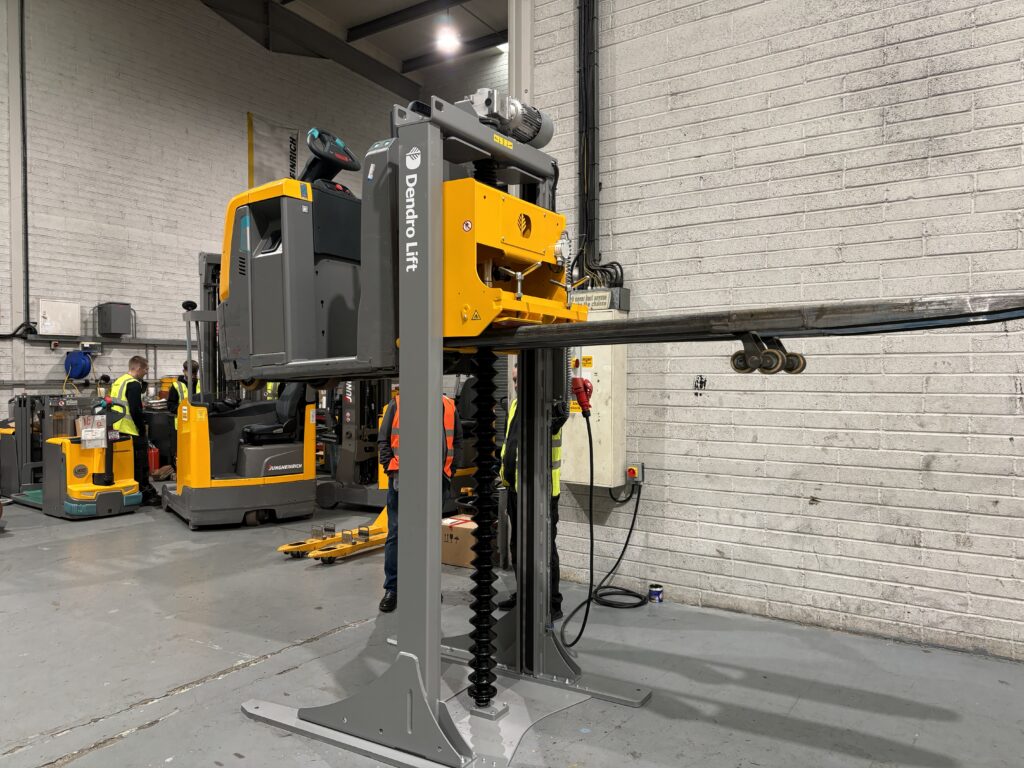
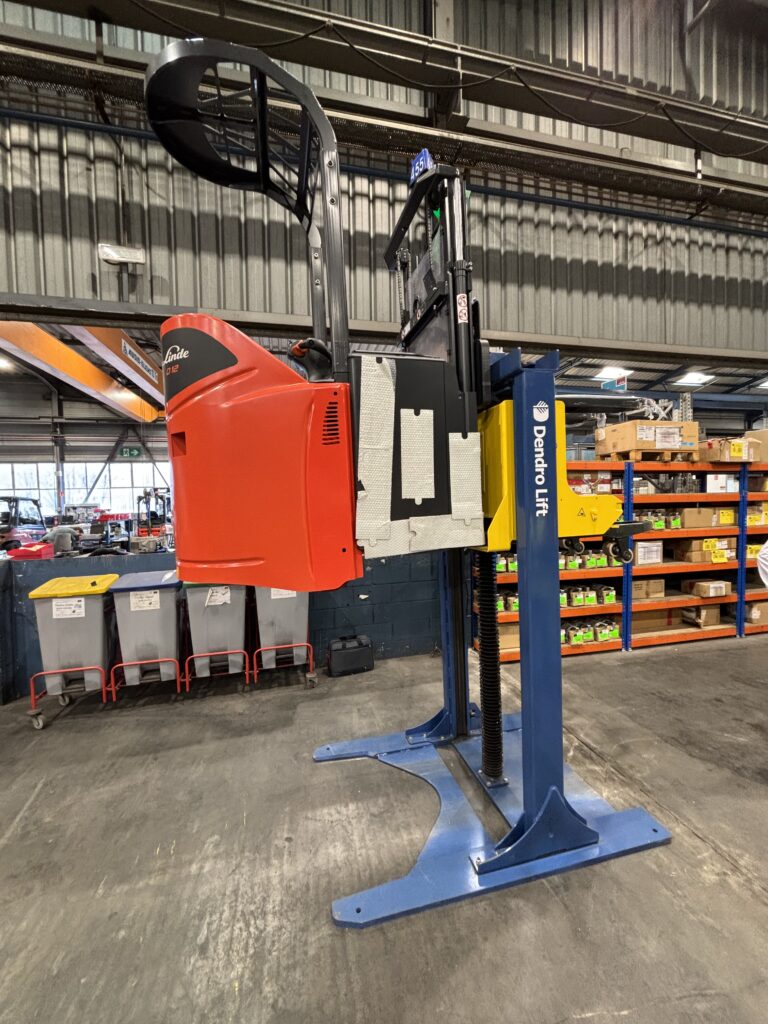
With the DSS2, the stacker can be raised to a better working height. The technician gets a more ergonomic working position and can adjust the height to suit the task.
The DSS2 Premium is designed for the service of stackers and pallet trucks. It provides a comfortable working position when servicing raised vehicles and offers a maximum lifting height of 1,800 mm.
This makes a major difference in recurring service work where the same tasks are carried out several times per day.
2. Poor access to important components
During stacker service, the technician often needs access to several parts of the truck. This may include the motor, batteries, brakes, wheels, caster wheels, fork wheels and wheel suspension.
If the stacker is standing directly on the floor, or if it is lifted with equipment that blocks access, the work becomes more difficult than necessary. Poor access often leads to longer service times, repeated adjustments and more demanding working positions.
The solution:
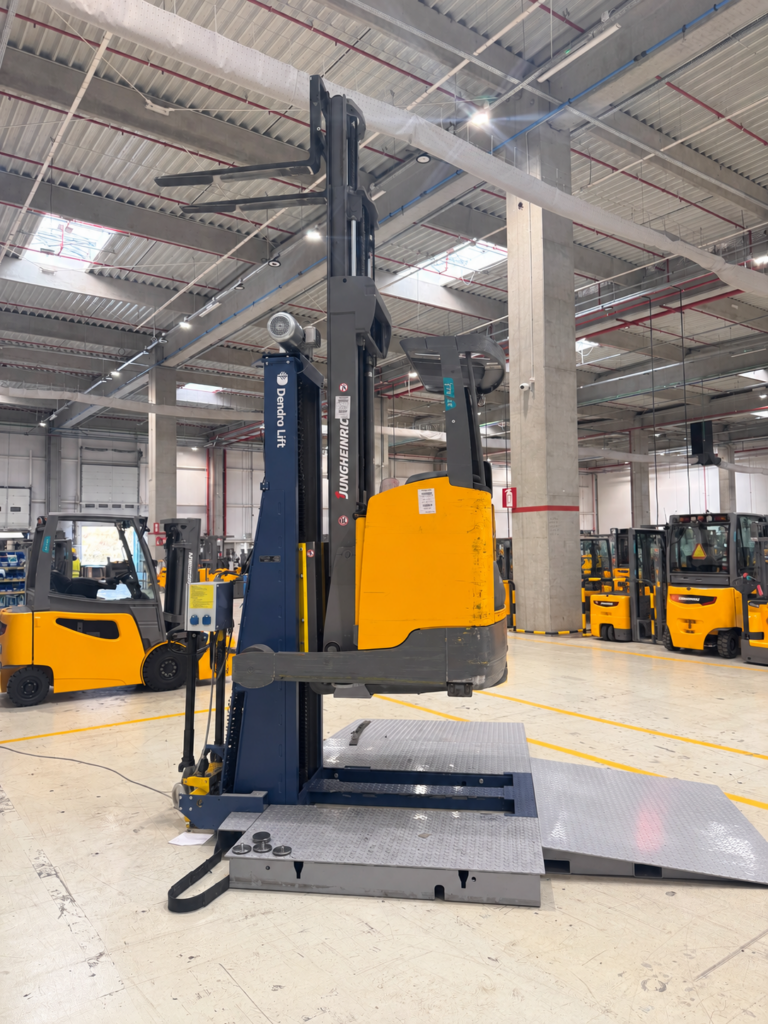
The DSS2 Premium is tailored for the service of stackers and pallet trucks. Its design makes it easier to access the motor, batteries, brakes and wheel suspension. When the truck is raised, three sides remain free, allowing the technician to work more efficiently around the vehicle.
For workshops that also service counterbalance forklifts, the Dendro Lift CBL6 can complement the DSS2. The CBL6 is a mobile single-post lift for counterbalance forklifts up to 6,000 kg. It is designed for safe, quick and easy lifting of forklifts and provides good access to the motor, batteries, brakes and wheel suspension.
3. Time-consuming lifting before the work can begin
In many forklift workshops, several different methods are used to raise a stacker to service height. This may include jacks, blocks, another forklift or other temporary solutions.
The problem is that the lifting process itself often takes unnecessary time. When the lifting method varies between technicians, it also becomes more difficult to create a standardised service workflow.
The solution:
The DSS2 is built for quick and easy handling. By driving the stacker’s support legs and forks into the lift and securing them with the fastening screws, the truck can be raised to the desired working height in under a minute. The height can then be adjusted with the simple press of a button.
This makes stacker service more predictable. When lifting is quick, safe and repeatable, the technician can focus on the service work itself.
Independent test shows approximately 40% time saving with DSS2
In an independent test carried out by a leading forklift manufacturer, the Dendro Lift DSS2 was compared with traditional methods for stacker service. The test included removing and installing fork wheels, drive wheels and caster wheels. The work was carried out by experienced service technicians under standardised conditions.
Three methods were compared:
- jack and blocks
- lifting with a forklift
- Dendro Lift DSS2
The result showed that the DSS2 provided an average time saving of 39.59% compared with the other methods. The test also showed better ergonomics, good mobility, stable positioning, balanced weight distribution and very good access to components.
Jacks and blocks were considered portable, but the method required more physical effort, resulted in very low-level working and provided poorer access. Lifting with a forklift required additional safety measures, created uneven weight distribution and used equipment that was not designed for this type of service work.
For a forklift workshop, this means that the right lift for stackers can improve not only the working environment, but also the time spent on each service job.
4. Safety risks when lifting with another forklift or an overhead crane
In some forklift workshops, stackers are lifted using another forklift, a counterbalance truck or an overhead crane. This may seem like a quick solution, especially if the equipment is already available in the workshop. The problem is that it often creates a suspended load, or a situation where the vehicle is not securely supported on equipment designed for service work.
During service, the technician often needs to work close to, or underneath, parts of the vehicle. In that situation, it is not enough that the load is simply “raised”. It must be securely supported, and the equipment used must be intended for the task.
HSE states that, where it can be avoided, loads should not be suspended over occupied areas. If it cannot be avoided, risks to people must be minimised through safe systems of work and appropriate precautions. Areas below loads suspended for significant periods should be treated as danger zones with restricted access. OSHA also requires employers to use hoisting routes that minimise employee exposure to hoisted loads where available.
In the independent test carried out by a leading forklift manufacturer, the DSS2 was compared with lifting using a forklift. The test showed that lifting with a forklift required additional safety measures, created uneven weight distribution, limited access and used equipment not designed for this type of service work.
The solution:
With the DSS2, the stacker is raised in equipment specifically developed for stacker and pallet truck service. The truck is stable in the lift, the weight is evenly distributed and the technician has free access from three sides.
The DSS2 is also equipped with self-locking lifting nut assemblies, brake motors, emergency stop and limit switch functions for nut wear and obstacle control. The self-locking trapezoidal screw means no additional securing is required before work can begin on the raised truck.
This makes the DSS2 a safer and more suitable alternative than working close to, or underneath, a load held by another forklift or an overhead crane.
5. Non-standardised workflows in the forklift workshop
A common problem in forklift workshops is that different technicians work in different ways. One person lifts the stacker in one way, another uses a different method. Tools, spare parts and working positions vary between service jobs.
This may work at low service volumes, but with recurring stacker service it quickly becomes inefficient. It also becomes harder to train new technicians and maintain consistent service quality.
The solution:
With a dedicated lift for stackers, the service bay becomes more standardised. The DSS2 provides a clear method for how the stacker is driven in, secured, raised and serviced.
The DSS2 Premium is also equipped with a practical shelf for tools and spare parts. This helps keep the workplace more organised and supports an efficient workflow throughout the service job.
For workshops servicing many stackers and pallet trucks, this can contribute to shorter lead times, better ergonomics and more consistent working routines.
CBL6 complements DSS2 in workshops with mixed forklift fleets
Many forklift workshops do not only work with stackers and pallet trucks. The same workshop often services counterbalance forklifts as well, including electric, gas and diesel-powered models.
In these cases, the DSS2 can be complemented by the Dendro Lift CBL6.
The CBL6 is a mobile single-post lift for counterbalance forklifts up to 6,000 kg. It takes up less space than traditional two-post or four-post lifts and does not need to be bolted to the floor.
The CBL6 can raise the truck to the desired working height in around one minute and offers a maximum lifting height of 1,800 mm. With three free sides and all wheels free, it becomes easier to access the parts that need service.
For complete forklift workshop equipment, the division is clear:
- DSS2 for stacker and pallet truck service.
- CBL6 for counterbalance forklifts up to 6,000 kg.
- Jack stands and customised lifting solutions for special vehicles, loads and service tasks.
Together, DSS2 and CBL6 give the workshop a more flexible and efficient solution for different forklift types.
The right forklift workshop equipment makes a difference
Stacker service requires more than technical skill. It requires the right equipment, the right working position and a safe method for lifting the vehicle.
With the DSS2, the workshop gets a lifting solution developed specifically for stackers and pallet trucks. It is designed to improve access, ergonomics and service safety.
The DSS2 Premium is suitable for most stackers up to 2,500 kg. It has a maximum lifting height of 1,800 mm, stands freely on the floor and only requires a 16A three-phase outlet. It can also be moved with a counterbalance forklift when needed.
For workshops that also service counterbalance forklifts, the CBL6 provides similar advantages for heavier forklifts up to 6,000 kg.
See how DSS2 and CBL6 can improve your service workflow
Do you want to make stacker service, pallet truck service and counterbalance forklift service safer, faster and more ergonomic?
See how DSS2 and CBL6 can improve the service workflow in your forklift workshop.