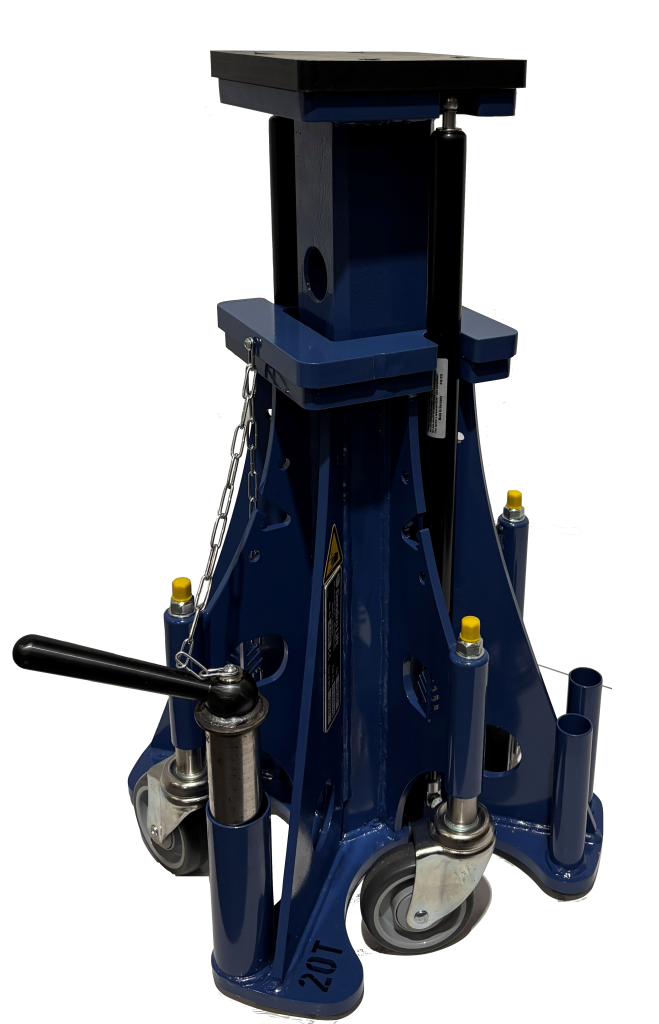


Jack Stands – How to Choose the Right Model for Your Workshop
Jack stands are used to support static loads during service, maintenance, and industrial operations. Selecting the right model is based on load capacity, stability, geometry, and handling.
This guide outlines the most important technical parameters, with particular focus on height adjustment and ergonomics.
Function and Application
Jack stands are designed to:
- support loads over extended periods
- relieve lifting equipment
- ensure stability during work
They are used in service, assembly, and industrial applications where a load must remain stable over time.
Load Capacity and Dimensioning
Dimensioning is based on rated load (maximum load).
In industrial applications, jack stands can handle loads of up to 100 tonnes, depending on design and configuration.
Key parameters:
- static load
- eccentric loading
- load distribution on the top plate
Stability and Safety Requirements
Stability is determined by geometry and verified through established test methods.
Typical requirements:
- height ≤ 4.5 × tipping radius
- floor pressure ≤ approx. 2 MPa
- ≥ 1.6 × rated load without permanent deformation
- ≥ 3 × rated load without failure
This ensures functionality even under non-ideal load conditions.
CE Marking and Compliance with Standards
All jack stands from Dendro Lift are CE marked and manufactured in accordance with applicable Swedish and European regulations.
This means that the products:
- meet defined safety requirements
- are verified according to established test methods (e.g. NT MECH002)
- are designed with documented safety factors
CE marking is not a formal detail, but a fundamental requirement to ensure that the jack stand performs as intended under real operating conditions.
In practice, this means:
- the structure is tested for overload and inclination
- stability and strength are verified
- the user can rely on consistent performance over time
In industrial applications, where the consequences of failure can be significant, this is a critical factor in selecting jack stands.
Gas Spring Assisted Height Adjustment
To address handling challenges, gas spring assisted systems are used.
Principle:
- the gas spring balances the weight of the center column
- the effective weight is significantly reduced
- adjustment can be performed in a controlled manner with low force
Effects:
- significantly reduced handling load
- reduced risk of pinch injuries
- improved control during both lifting and lowering
In practice, this allows even heavy components to be adjusted with high precision and without sudden movements.
This type of solution is unique to Dendro Lift and is not available from other manufacturers on the market.
Alternative: Trapezoidal Screw
Another common solution is the trapezoidal screw:
- continuous height adjustment
- self-locking function (prevents unintended lowering)
It provides high precision but does not eliminate the issue of manual handling in larger designs.
Mobility and Handling
High-capacity jack stands are often heavy.
Therefore, they are equipped with:
- spring-loaded wheels
- swivel wheels with brakes
Under load, the wheels are unloaded, ensuring direct contact with the floor during operation.
Design and Variants
The choice of design depends on the application:
- 3-leg jack stand – positioning close to the object
- 4-leg jack stand – more compact footprint
- double jack stand – for wide or heavy objects
- fixed or adjustable height
4-leg designs can require approximately 20% less space at equivalent height.
Top Plates and Load Interface
The top plate must match the geometry of the load.
Variants include:
- flat
- V-shaped
- radius-adapted
For higher loads, reinforced and often fixed top plates are used.
Summary
The selection of jack stands should be based on:
- correctly dimensioned load capacity
- verified stability
- suitable design for the application
- safe and controlled height adjustment
Especially in larger designs, handling and ergonomics become critical, where gas spring assisted adjustment offers a clear technical advantage over traditional solutions.